
Breaking the Fourth Wall
Conversations with Soul, Spirit and Silence

I’m standing at the kitchen sink watching a great tit flit back and forth between the bare branches of the Victoria Plumb, the silvered arms of a Himalayan Birch, and the lichen-covered branches of a Cox’s Orange Pippin, which is leaning at 60 degrees, wind buffeted as it has been for nearly six long Fenland winters.
After observing this for some time, I realised that this little bird is indeed circling; plum, birch, apple, and then round again, plum, birch, apple.
I find myself deepening into this circular frenzy as if it were some kind of meditation offered up by the morning, and I notice myself slowing down, my breathing eases, my shoulders drop a little, all helped along by the gentle backing music of the Irish bank, The Gloaming.
I could, of course, have dismissed the significance of this moment, or at least downplayed it, but the symbolism of a bird doing circles in my tiny garden was not lost on me.
Circles have become both an important part of my personal process, and professionally, too, offering a way of folks to come together in spaces known as Circles of Trust.
Circles show up in some of my favourite poems too, especially in a short, but punchy poem by Rilke,
I Live My Life

Rainer Maria Rilke

I live my life in widening circles
that reach out across the world.
I may not complete this last one
but I give myself to it.

I circle around God, around the primordial tower.
I’ve been circling for thousands of years
and I still don’t know: am I a falcon,
a storm, or a great song?
‘Conversations with Soul’
Can you imagine yourself as a Great Song?
What about a Falcon?
Or an abundant fruit tree?
What is the nature of your soul?
This poem circles me, like the tail end of a great storm moving across the flat Fenland that surrounds me.
As for birds, well, Joe Paddock reminds us that often it’s a bird that brings a synchronous moment into our lives, and Joe, in his book Infinity’s Edge, shared Thomas R. Smith’s poem to make this point
“Often It’s a Bird”

Often it’s a bird, like that chick-
adee that came to the novelist
in the snow, to perch on his pick-handle
as he rested from burying his wife’s
urn: “I felt like Saint Francis.”

Golfing in October, a week after
Dad’s funeral, my brother watched
a crow that had followed him
strut across the green and tip
the ball into the hole with its beak.

The eagle that drifts over the cemetery,
the swallow that darts inside the chapel…
whenever we’ve lost someone, as if to tell
us we neither abandoned nor alone,
the one thing we most need to know.
‘Conversations with Spirit’
What is the one thing your spirit, your daimon, most needs you to know?
Where is your chapel?
I recall now, one long summer a couple of years ago, being in a small room at Martin Shaw’s school of myth. It was summer school, it was morning, and it was already warm, and the sash windows were drawn down. We started the day in the usual way, with Martin reading poems from the front and then inviting all of us there to write our own poem in response to anything that had arisen either that morning or the prior night in our dreams.
This process is known simply as ‘the 5-minute poem’ because we literally only get given that amount of time to scribble something down. And once that time had passed, the room was invited to read our poems aloud.
It was then that a young man to my right began reading a poem about his late grandfather, and a truly remarkable thing happened. As he reached the point in his short poem where he referred to a bird, a swallow flew in through the open east-facing window at the back of the room, did a double circle around the chandelier hanging in the centre of the room, and duly exited out of the open north-facing window.
Well, I can tell you, there was a short, audible gasp among us, and then the entire room fell silent.
I’m sure some of you reading or listening to this may well remember that moment; it’s one that I’ll certainly never forget.
So…Often it’s a bird.
You have five minutes: What is the poem your soul or your spirit needs to write.
Back in December, I attended another of Martin’s weekends, but this one was different, entitled, as it was, Wild Christ and to be honest, at face value, it wasn’t a weekend that immediately appealed to me, but I had a pull to be there.
I seem to recall Martin only telling three or perhaps four stories that weekend, partly because he was joined by other guest speakers and teachers. Fortunately, it was an opportunity to once again hear Gawain and the Green Knight, a story I’ve heard him tell several times now, and one that gets better each time. He told another story, one from the Old Testament, called Blind Tobit, which again would not be a story I would usually encounter, but was one that had some curious details I may well revisit in one of these future posts.
But the story that has really gripped me is one called the Voyage of Brendan, a story from Ireland. There was much in this story, but the detail that struck me most was that on Brendan’s voyage, he found himself encountering three islands. The first island, which happened to turn out to be the back of an extremely large whale called Jasconius, represented the island of Soul, those deep watery depths of soul. The second island he came to was an island with birds, rising high into the sky, which the storyteller told us symbolised Spirit. That made for quite a familiar pairing, soul and spirit, one goes down into the watery deeps, whilst the other rises like flames. But then came a twist, because we find out that Brendan visits a third island. Now this island was even more curious because it contained a congregation of monks who for decades and decades had never spoken a word, and so this island symbolised Silence.
At this point, I expected Brendan to complete what he needed to do on the island of silence and then continue his onward journey in a regular, linear fashion. But this is myth we’re talking about, and alas, that was not the case, because it turned out that Brendan’s voyage was not a straight line dash, and he was not able to move on from the island of silence but rather found that he had to circle back to soul, then to spirit, and then again to silence.
And so it went on for seven years!
‘Conversations with Silence’
As you quietly reflect, what island do you find yourself on in this moment? Soul, spirit or silence?
How long have you remained silent?
What do you need to say?
Is it time to say it?
Circles have visited me once again in recent days, studying as I have been with Thomas Moore and his Imaginal Psychology.
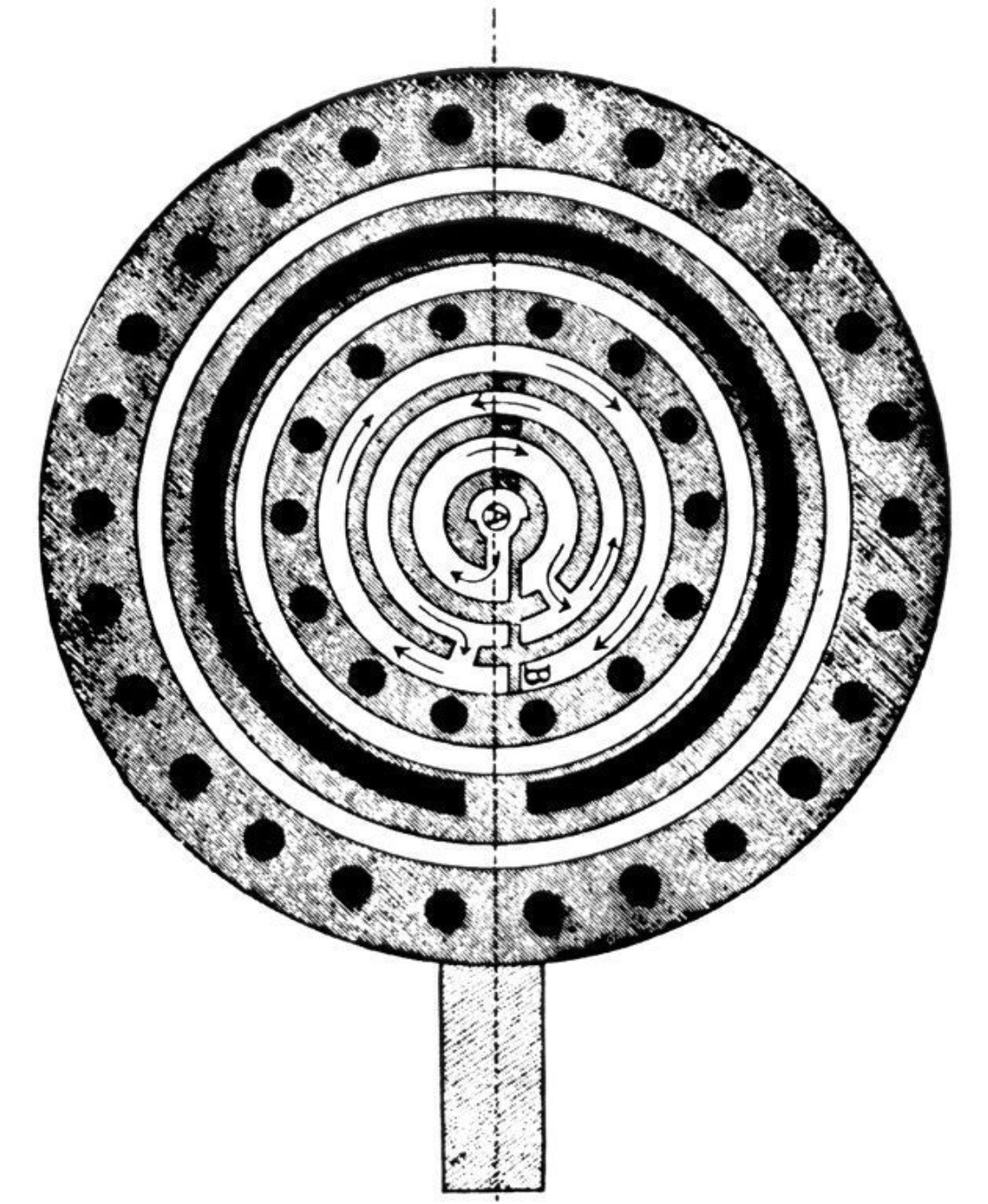
We have been learning about the Greek God of healing, Asclepius. And one important thing I learned about Asclepius was that in Greece, there would be a temple or sanctuary devoted to him, called the Asclepieia. One of the buildings that is known to have been found here was a circular stone structure known as a ‘tholos’. The tholos, as well as having circular walls, also had a domed ceiling, and if you needed healing, respite or recovery, you could come and enter the tholos to spend a night there. The ritual that surrounded this healing process was known as incubation.
At the tholos in Epidaurus, the ground floor was that of a labyrinth, and some of these labyrinthine ground floors were known to have had water flowing through them. I can only begin to imagine how beautiful they must have been.
Perhaps beauty is central to healing?
The tholos would also have had fountains at the entrance for folks to clean themselves before entering.
And here’s C.A.Meier from his remarkable book, Healing, Dream and Ritual: Ancient Incubation and Modern Psychotherapy.
“Water played an important part throughout the cult of Asclepius. It was almost as outstanding a feature as the sacred serpents and dogs. The fountains and bathing pools were never mineral or hot springs, despite a widespread belief to that effect. They simply belonged to Asclepius as a chthonic god, just as his serpent did. It is only through the connection with the god that the spring became a hagiasma (“healing spring”). All the dii chthonii had a pēgē (“spring”) in or near their sanctuaries.”
One lovely additional thing I learned is that anyone could undergo the incubation rite, but someone could also travel to the tholos for someone else who was too sick to be there themselves. In otherwords, they could go in their place.
‘Conversations with Soul, Spirit, Silence.”
Where is your nearest ‘tholos’?
What needs incubation?
Who might need you to stand in their place?
Can you create a tiny fountain somewhere close by?
Can you imagine how healing the silence must have been in the asclepieia?
Well, that feels a lot, hopefully not too much, so in closing, I’ll share my attempt at an orphic hymn to Asclepios and invite you to break the fourth wall between your everyday mind and your soul (your deepest self), your spirit (or daimon), and the silence that either surrounds you or is inside you.
Orphic hymn to Asclepios

Asclepius, dweller at the circular centre of tholos,
At the fountain-fringed temenos.

Oh, you, of the watery temple
Of the chthonic realm,

Where lunar light and solar dream
Meet in sacred congregation.

Stay the night,
Stay the week,
Stay quite as long as you like.

Come for yourself,
Come for someone else.

Rest here in their stead,
Let this stone floor be a
Healing bed.

Turn away from all distraction
Welcome to your incubation.
What is the dream that inhabits your soul?
Nice piece Will, and I wrote my 5 minute poem some years ago on the 40th anniversary of my father's death...
My father was a storyteller;
A teller of tales
Yet,
I cannot now remember his voice
Beautiful Will! 🙏❤️